

Bipolar disorder affects 2.8% of adults in the US. It is a serious, yet treatable, mood disorder. It’s important for us to gain a greater understanding of bipolar disorder and treatment options so that people who have it can live fulfilling lives without stigma.
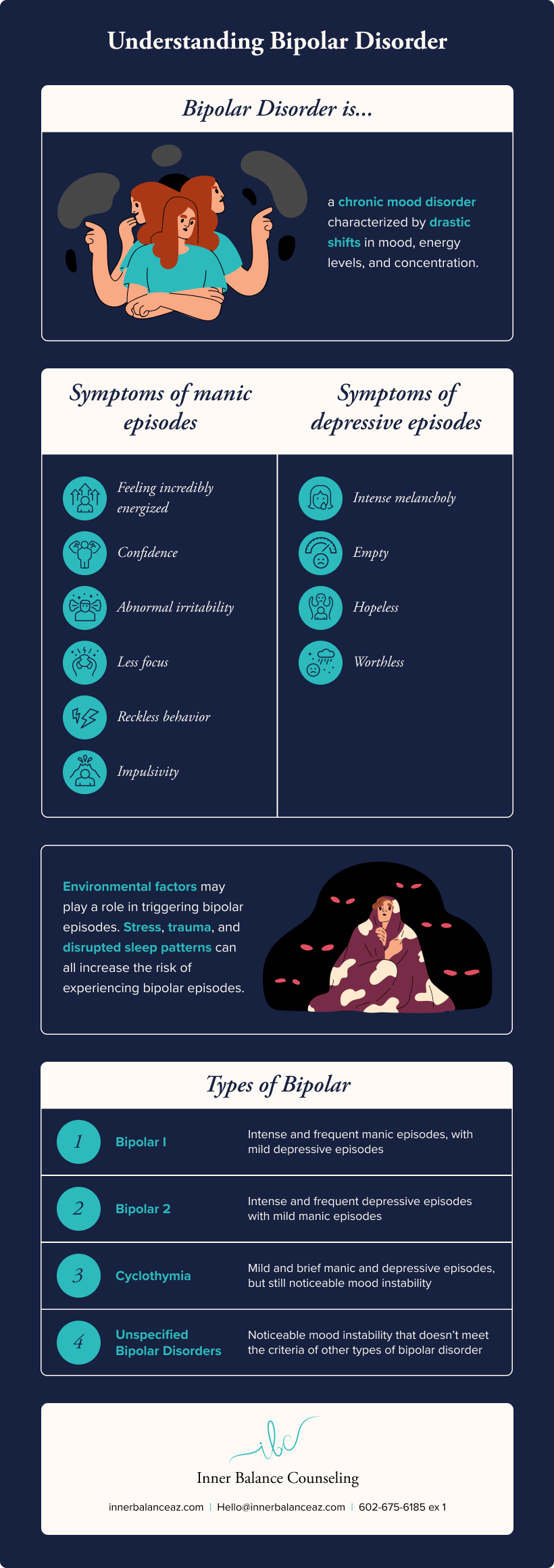
Bipolar disorder is a chronic mood disorder characterized by drastic shifts in mood, energy levels, and concentration. It used to be referred to as manic-depressive disorder or manic depression.
Bipolar disorder not only affects a person’s mood, it can also affect their ability to:
Bipolar disorder is similar to many mental health disorders such as depression and anxiety in the way it takes a toll on your cognitive abilities and executive function. They also share many symptoms.
Like all mental health disorders, the symptoms of bipolar disorder and their severity are different for everyone. They can also change throughout a person’s life. It’s a lifelong disorder and people can go through seasons of more and less severe symptoms, and sometimes, no symptoms at all.
Bipolar disorder is identified by manic, depressive, and hypomanic episodes of intense emotions and behaviors. Typically, the behavior during these episodes is out of character for that person.
Most people with bipolar disorder experience two manic and depressive episodes each year. Experiencing four or more episodes per year is referred to as rapid cycling.
Manic episodes are times of intense highs. These episodes are usually defined by feeling:
Behaviorally, mania is seen in a few ways:
Manic episodes can disrupt work, school, and relationships. On rare occasions, severe mania can lead to psychosis such as delusions or hallucinations.
Depressive episodes are the opposite. They are extreme low periods that align with symptoms of major depressive disorder.
In a depressive episode, a person will feel:
Depressive symptoms can cause people to lose all interest in things they used to enjoy. They may sleep too much, be restless, and have a loss of energy.
Episodes of depression also lead to problems in work or school, social settings, and in relationships.
Sometimes, people with bipolar disorder experience symptoms of both mania and depression at the same time. This is called a mixed episode. A person may feel incredibly energized while at the same time feeling hollow and empty.
Hypomania is a milder form of mania with less severe symptoms. It doesn’t necessarily interfere with someone’s day-to-day life. During a hypomanic episode, most people can still perform at work and in social situations without much difficulty.
We don’t entirely know what causes bipolar disorder, or that it can even be boiled down into one single factor.
Research has found that brain structure and function in people with bipolar disorder differs slightly from the brain of someone unaffected by the disorder. There are physical differences, chemical imbalances, and brain activity that is dysregulated when compared to a typical brain.
This information is not currently used for diagnosis, treatment, or prevention, but may eventually help in these areas and provide more understanding of the disorder.
Environmental factors may also play a role in developing or triggering bipolar episodes. Stress, trauma, and disrupted sleep patterns can all increase the risk of experiencing bipolar episodes.
Drug and alcohol misuse can also be a risk factor in making a person more vulnerable to episodes associated with bipolar disorder.
Genetics and family history are also thought to influence a person’s likelihood to develop bipolar disorder. If you have a closely related family member who is affected by bipolar disorder, you are more likely to be diagnosed with it as well. Researchers are still trying to discover which genes are specifically involved.
Because of the varying levels of manic and depressive episodes, medical professionals have broken down bipolar disorder into several subtypes. The difference between these subtypes has to do with the symptoms someone experiences, the severity of those symptoms, their duration, and their pattern.
People with bipolar I disorder experience extreme highs. Bipolar I is characterized by the experience of one or more episodes of mania in between euthymia (baseline mood) and depressive episodes.
In order to be diagnosed with bipolar I, a person must have experienced either:
While someone with bipolar I can experience both mania and depression, depressive episodes are not required for a doctor to make this diagnosis. Sometimes people bounce between manic and hypomanic states. It is also possible for someone with bipolar I to experience mixed episodes.
Bipolar II disorder is characterized more by extreme depressive episodes. Individuals suffering from bipolar II will flux between depression and hypomania.
While someone with bipolar II won’t experience the extreme mania as someone with bipolar I, they will experience much more severe depressive episodes. These depressive episodes are often severe enough to be considered major depressive disorder.
Cyclothymic disorder is the diagnosis used for people with chronic mood instability that doesn’t quite meet the criteria for bipolar I or II. Someone with cyclothymic disorder will have mood swings that are either not as severe, not as frequent, or not long enough to be classified as bipolar I or II.
A person with cyclothymia still experiences episodes of hypomania and depression, but they are brief. To be diagnosed with cyclothymic disorder, a person has to have been experiencing these recurring highs and lows for at least two years.
Some people still experience abnormal mood shifts significant enough to be clinically acknowledged but still do not meet the diagnostic criteria of bipolar I, II, or cyclothymia. This type of abnormal mood shift is classified as either other specified or unspecified bipolar disorder.
A person with cyclothymia still experiences episodes of hypomania and depression, but they are brief. To be diagnosed with cyclothymic disorder, a person has to have been experiencing these recurring highs and lows for at least two years.
Bipolar disorder is tested for and diagnosed similarly to other mental health disorders like depression or anxiety. A doctor will ask a list of questions regarding thoughts, feelings, or behaviors.
In order to be diagnosed with bipolar disorder, someone must have experienced manic and depressive episodes. Because different people experience different lengths and severities of these episodes, a doctor may ask about a specific time frame of these episodes, usually six months. They’ll also ask about family history of bipolar disorder, as there is a strong genetic component to developing it.
Part of the mental health assessment also involves ruling out other disorders, such as schizophrenia and depression. They may also perform physical exams to rule out anything that can cause symptoms that mimic bipolar disorder, including hyperthyroidism.
Bipolar disorder is a serious mental health disorder that should be addressed with professional treatment. Those who have it can manage symptoms and lead happy and healthy lives.
A professional can diagnose the disorder and find the right treatment options that work best for each individual. Bipolar disorder is often accompanied by other mental health issues that may also need treatment.
Talk therapy is beneficial in many ways.It can help someone with bipolar disorder:
Regularly seeing a therapist can help hold you accountable to stick with your treatment plan and manage stressors.
Once you find a treatment plan that works for you, it is important to stick with it even in times you feel good and “normal.” Stopping treatment may trigger an episode or increase the severity of one.
The top therapies for treating bipolar disorder are:
Also called CBT, cognitive behavioral therapy is the gold standard for taking control of our emotions and actions. It helps clients tie together thoughts, feelings, and actions. When someone with bipolar disorder understands why they’re doing something, feeling a certain way, or thinking about something, they can change those processes.
Dialectical behavioral therapy, or DBT, was originally developed to treat borderline personality disorder, but it has been proven effective in treating many conditions. DBT is based around improving emotional regulation. When someone understands their emotions, they can accept them and move on.
Also based around improving emotional regulation, interpersonal and social rhythm therapy helps people stay balanced with daily routines. ISRT therapists believe that much stress stems from disruptions to your daily routine, also called your social rhythm. These stressors can lead to a manic or depressive episode.
ISRT helps those with bipolar disorder create social rhythms that can help stabilize their mood and better cope with disruptions that cause distress.
Treatment plans for bipolar disorder often require a combination of both medication and therapy.
Common medications include:
It may take some trial and error to find the right medications for each person

Our therapists specialize in trauma therapy, CBT, and DBT. We have the experience to help you regulate your emotions and own your thoughts without any judgment or stigma.
No matter what battles you face, you have the power to create the life you dream of. Let us help you get there.
Today to get started!
Check Your
Insurance Coverage
Testimonials

“The staff at Inner Balance Counseling is very professional and supportive. They guided me to Jennifer Rizzo. I’m very glad that they did. Jennifer is professional, caring, and always knew what to do and say. Jennifer is also very accommodating to my needs and schedule. I highly recommend Jennifer and Inner Balance Counseling.”
-Richard L.
Meet Our Providers

YOUR PAST DOESN’T DEFINE YOUR FUTURE