

We often think of trauma as a personal experience that affects us on an individual level. While this is true, trauma can also be a shared experience that impacts us on a larger scale.
Certain events can have a widespread, damaging impact on entire populations. These events lead to collective trauma that can reshape societies, group identities, and cultures. This collective trauma often gets passed down through generations, affecting individuals long after the original trauma occurred.
Let’s take a look at what trauma is, how it can be passed down through generations, and how it can be healed.
Trauma can come from many different experiences, and each traumatic experience affects an individual in a unique way. Although there are many different types of trauma, the three main types are:
Acute trauma stems from a single, isolated event. It’s often associated with car accidents, physical or sexual abuse, or the unexpected loss of a loved one. This form of trauma leads to immediate anxiety, depression, or distress, and it can cause someone to have a lasting fear that a similar event will happen again.
Chronic trauma usually comes from experiencing a prolonged period of intensely stressful or dangerous events. This type of trauma can come from chronic illness, long-lasting domestic abuse, or homelessness. Chronic trauma can lead to a variety of lasting mental health conditions, such as depression, anxiety, or posttraumatic stress disorder (PTSD).
Complex trauma usually stems from childhood, and it often occurs when a child witnesses or experiences distressing or dangerous events over a long period of time. In all cases, it’s a violation of the close bonds of its caregivers. Complex trauma can come from child abuse, child neglect, or witnessing domestic violence. This form of trauma can cause someone to distrust others, have a bleak outlook on their future, or view themselves in a negative light.
Read our related article for more information on complex trauma.
Intergenerational trauma is a unique form of trauma that gets passed down from generation to generation. On a smaller scale, intergenerational trauma can occur within specific communities, or even individual families. On a larger scale, trauma can get passed down within entire countries or large parts of the world.
This type of trauma occurs when a group of people experience a traumatizing event, and they pass their trauma to their children. Intergenerational trauma can affect individuals long after the original event occurred, whether they’re aware of it or not.
Intergenerational trauma can stem from any traumatic experience that affects a large population. Large-scale trauma forces affected individuals to develop survival techniques and methods of coping that eventually gets passed down to their children.
Intergenerational trauma commonly stems from historic events including:
In addition to historic events, many societies enforce systematic oppression that can lead to long-lasting intergenerational trauma. Discrimination, racism, and other social injustices can force a marginalized population to develop survival mentalities that get passed down through generations. Even after a population is freed from oppression, they often carry on the same survival mentality and emotional scarring.
Despite not experiencing the original trauma, future generations can still feel its effects. Large-scale traumatic events often result in specific psychological, behavioral, and societal impacts that get passed down from generation to generation.
Some examples of the psychological harm caused by intergenerational trauma include:
In addition to psychological harm, intergenerational trauma can also increase the likelihood of developing harmful behavior patterns. Some examples of negative behavior patterns include substance abuse, relationship difficulties, and struggles with parenting. Children often pick up these negative behavior patterns from their traumatized parents, and they’re likely to pass them to their children.
Intergenerational trauma can reshape societal norms and expectations. For example, when displaced populations are removed from their homeland, it prevents their children from experiencing their cultural background. Marginalized populations often carry a distrust of their government and institutions, leading to social isolation, fewer opportunities for growth, and economic disadvantages.
Read our related guide for an in-depth look at PTSD.
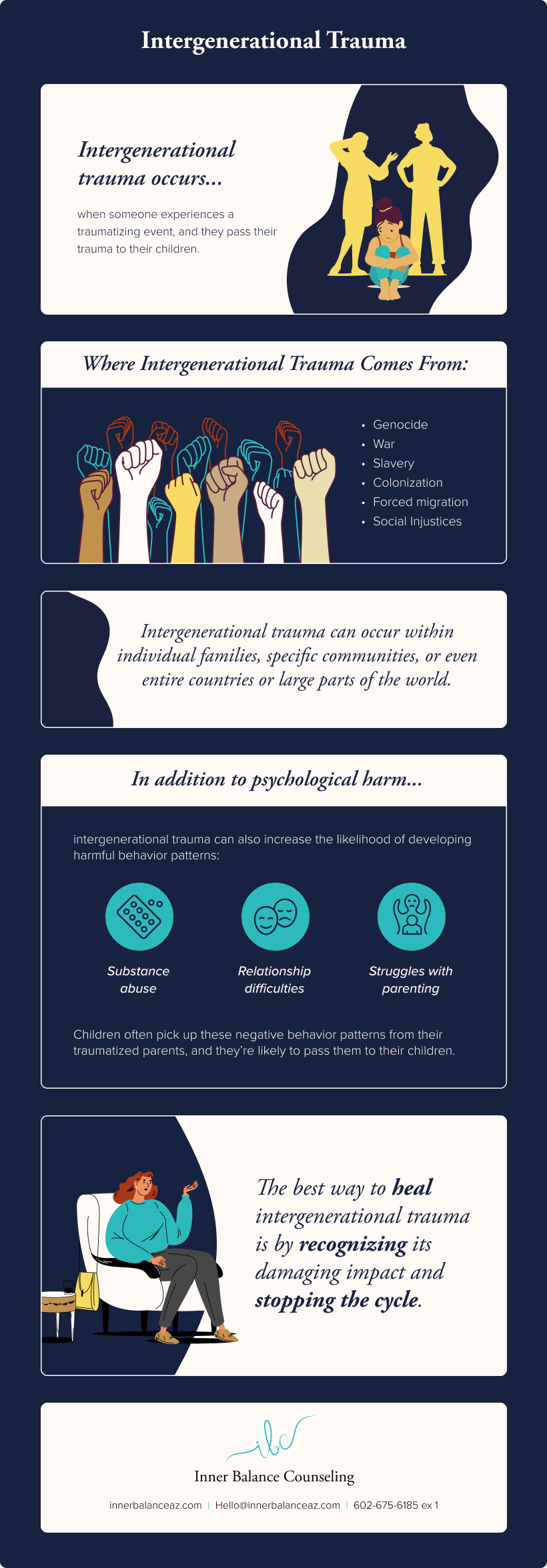
The best way to heal intergenerational trauma is by recognizing its damaging impact and stopping the cycle. Although this can be difficult on a large scale, it can be particularly effective on an individual scale.
Trauma therapy can help individuals recognize their underlying trauma and develop strategies for overcoming it. Trauma therapy provides a safe space for individuals to explore their struggles and understand how trauma is affecting them and their families.
After identifying how trauma is negatively impacting them, they can learn how to develop healthier ways of thinking and behaving. This will break the cycle by giving individuals healthier coping strategies to pass along to their children.
Family therapy can also help stop the cycle of intergenerational trauma. It provides an opportunity for families to learn how to navigate challenges and express themselves in a healthier way. This helps set a positive example of how a healthy family thinks and behaves, which can serve as the expectation for generations to come.
Read our related guide for an in-depth look at trauma therapy.
At Inner Balance, we believe that trauma treatment should be unique to each client and their experiences. Our trauma-informed approach ensures that every client gets personalized, compassionate, and effective treatment to overcome the impact of their long-lasting trauma.
If you or a loved one could benefit from professional trauma treatment, reach out to our mental health experts today.

At Inner Balance Counseling, we know addiction wreaks havoc in people’s lives. It can even be a struggle to get through daily life.
It will take work and commitment, but living a life without addiction is possible. Many people recover and go on to live the lives they truly want, no longer shackled by the chains of addiction.
Reach out. Show up. Feel Better.
Check Your
Insurance Coverage
Testimonials

“The staff at Inner Balance Counseling is very professional and supportive. They guided me to Jennifer Rizzo. I’m very glad that they did. Jennifer is professional, caring, and always knew what to do and say. Jennifer is also very accommodating to my needs and schedule. I highly recommend Jennifer and Inner Balance Counseling.”
-Richard L.
Meet Our Providers

YOUR PAST DOESN’T DEFINE YOUR FUTURE