

Usually each person in a relationship has something they take charge of, like finances, maintaining the house, planning trips, or caring for the family. In healthy relationships, these duties are fairly split, and if one person can’t fulfill their duties, the other person can help. This includes emotional labor like ensuring intimacy and romance in the relationship.
It’s when these duties aren’t split, or the other person can’t or won’t help that things drift into unhealthy territory.
Workplace romances are a tale as old as time. You’re spending eight hours a day, five days a week with the same people. It’s natural that some bonds develop. While a relationship with a peer can be troublesome in its own right, a romantic relationship between a boss and an employee is guaranteed to create an unhealthy power dynamic.
Romantic relationships shouldn’t involve a lot of commanding, but the work environment dictates it. It’s not easy for a person to hear their partner say that they’re on a work improvement plan. The boss partner may give preferential treatment which leads to a strained working environment with coworkers. In worse cases, annoyances at home can affect the work environment and vice versa.
Even if one partner isn’t your direct superior, they still hold privileges and power that the other person doesn’t.
Finding a partner that makes more than you can feel like you hit a home run. While the extra income isn’t necessarily the problem, the way the higher earner behaves because of it can be.
Abusive partners may hold the fact that they make more money over their partner’s head. It makes them feel like they get to make the decisions about the household because they fund the majority of it.
This can be especially apparent in stay-at-home spouse situations, where one person doesn’t bring in a salary at all. They completely rely on their partner to support them financially.
Emotional differences also lead to unhealthy dynamics. The way people interpret and show affection is wildly different. If they’re too different, power imbalances can develop.
Someone who is avoidant in relationships, not showing much outward affection, can hold power over their partner who needs more attention and reassurance. In an unhealthy power dynamic, that avoidant partner can withdraw affection completely, causing their more anxiously-attached partner to feel that they need to “earn” more intimacy.
Read more: Attachment Styles Part 1/4: Dismissive Avoidant.
Non-traditional relationships such as polyamory face many of the same challenges as monogamous relationships. Clear communication as well as shared goals and expectations are the keys to success.
One way they can develop an unhealthy power dynamic is when the relationship is set up with primary and secondary partners. The primary partners generally hold more power over the secondary partner, especially if that relationship was already established. Some poly couples will prioritize the primary relationship over the secondary relationship. While this isn’t necessarily unhealthy, some behaviors can make it so.
In all of these scenarios, and all relationships with a power imbalance, the power dynamics can be categorized into three distinct types:
When one person’s needs are intentionally not fulfilled by their partner, it creates a demand and withdrawal dynamic. The demand is whatever they need from their partner—time, support, physical affection, emotional connection, or household chores to name a few.
The withdrawal comes when the other partner distances themselves from these needs and wants. They may not respond to prove a point, or not prioritize their partner’s needs.
The demander can feel resentful, frustrated, and desperate. The withdrawer feels they aren’t giving in to selfish wants.
Distancer/pursuer may seem similar to demand/withdrawal. However, it is more apparent in relationships with different attachment styles. Those with anxious attachment may come off as clingy and devote a lot of energy into the relationship.
Those with avoidant attachment don’t place as much importance on emotional bonds, or at least are more reserved with displays of affection.
The pursuer would be the one wanting to spend more time with their partner, take pictures, cuddle, and do things together.
The distancer may feel like it’s too much and put less energy into creating a bond.
Rooted in trauma, this relationship dynamic involves one partner intentionally or unknowingly triggering the other person into feeling fear or shame. In abusive relationships, this fear response is weaponized. However, this dynamic is present in a lot of relationships; we just aren’t completely attuned to it.
The trigger can be a behavior, a few words, or specific action. Maybe a partner talks about their ex too much or mentions someone they find attractive that doesn’t look like their partner. Maybe they have family over for dinner too much. Whatever it is, the person doing the triggering holds power over the other person—even if it’s done unconsciously.
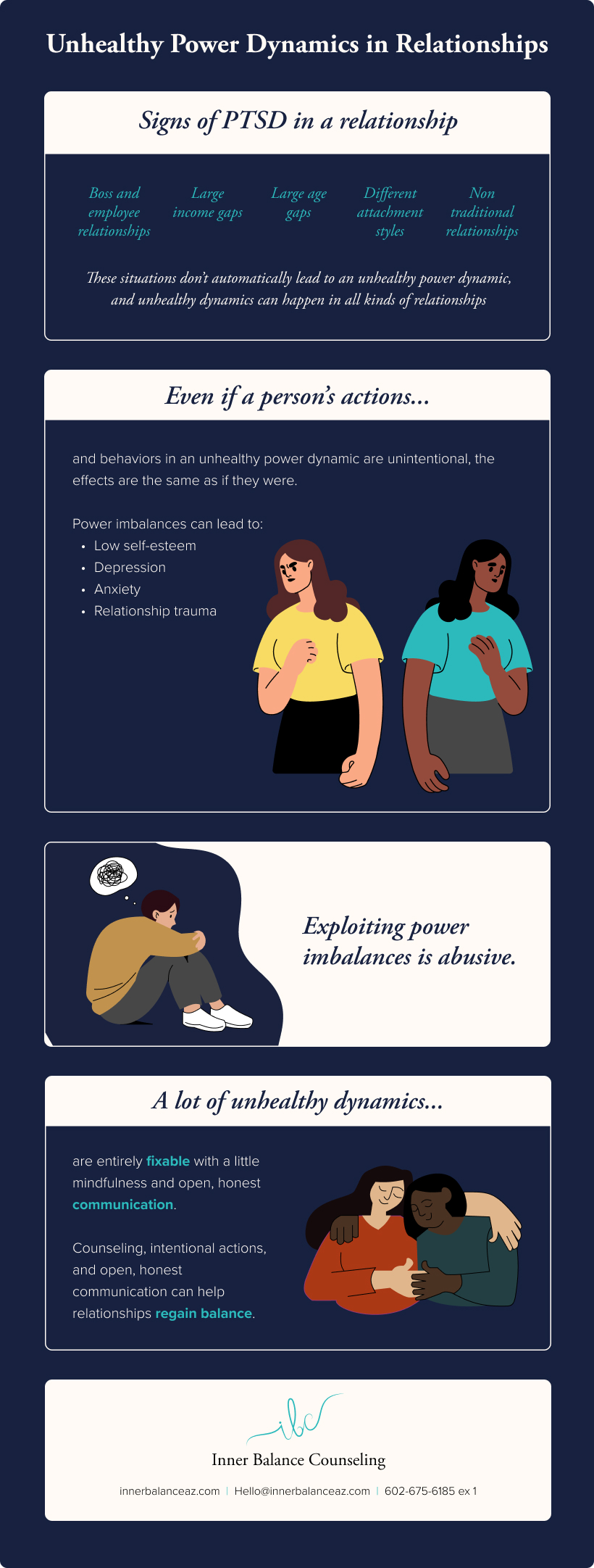
Their autonomy, confidence, self-esteem, and mental health can diminish if they feel they aren’t allowed to say or do certain things. They may develop depression or anxiety, and may even cause them to doubt what is normal in romantic relationships.
The impacts of unhealthy power dynamics can extend to other relationships. In friendships, the person with less power may feel nervous to ask for support. It might cause relationship trauma, and make that person scared to voice their opinions or be themselves in their next romantic relationship.
Exploiting power imbalances is abusive. Someone should never intentionally behave in a way that hurts their partner.
Related article: Healing from Emotional Abuse
A lot of unhealthy dynamics are entirely fixable with a little mindfulness and open, honest communication. Again, while some imbalances are created out of ill intent, a lot are created out of ignorance. Focus on remembering that you’re meant to be on equal footing with your partner, or partners, and put in some work to improve your dynamic.
As much as couples counseling can resolve communication and trust issues, individual therapy helps you overcome mental hurdles independent of your relationship. Perhaps you unknowingly take some of your partner’s power because of past trauma. Perhaps you give up a lot of power because of trauma, or because you never learned how to create boundaries.
If you don’t like the way you feel in a relationship, tell your partner! Keeping open lines of communication at all times may help everyone catch maladaptive behaviors early. Again, some unhealthy power dynamics are sneaky and develop over time. If you and your partner regularly discuss your feelings, you can nip an unhealthy dynamic in the bud.
Counseling will help you find the right words to say, and it is important to utilize the tools counseling gives you day to day.
A completely black and white “right and wrong” is incredibly rare. “Happy mediums” are far more realistic and common. There’s usually a way for you and your partner to meet in the middle so that neither of you completely compromises your needs.

Relationship counseling at Inner Balance isn’t just for couples, but for individuals who want help creating healthy power dynamics. Learn how to set boundaries, regulate your emotions, and see things from new perspectives.
Check Your
Insurance Coverage
Testimonials

“The staff at Inner Balance Counseling is very professional and supportive. They guided me to Jennifer Rizzo. I’m very glad that they did. Jennifer is professional, caring, and always knew what to do and say. Jennifer is also very accommodating to my needs and schedule. I highly recommend Jennifer and Inner Balance Counseling.”
-Richard L.
Meet Our Providers

YOUR PAST DOESN’T DEFINE YOUR FUTURE